
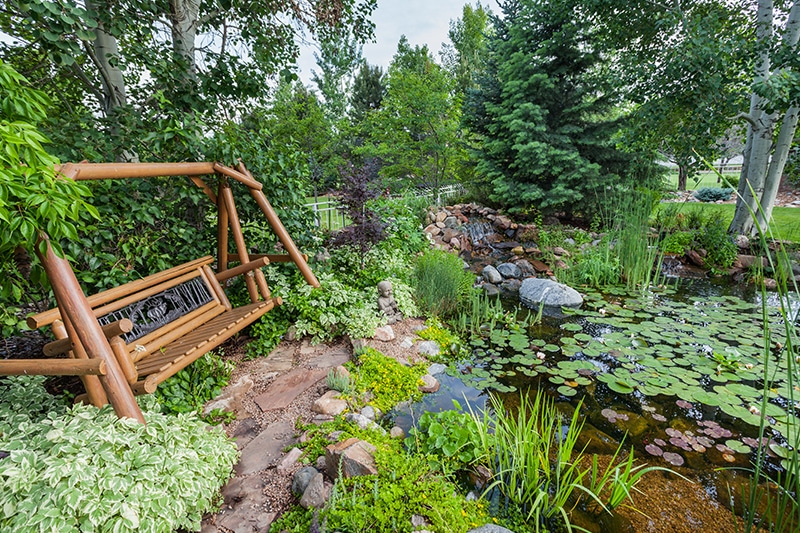
There’s something undeniably peaceful about watching koi glide through clear water, their vibrant colors catching the Colorado sunlight. But keeping these living jewels healthy in Boulder isn’t quite the same as maintaining a koi pond in, say, Southern California. Our region’s unique combination of high altitude, intense UV exposure, and dramatic temperature swings creates challenges that many pond owners don’t anticipate until they’re knee-deep in murky water and stressed fish.
We’ve spent years helping Boulder-area homeowners design and maintain thriving koi ponds, and we’ve learned that success comes down to understanding three fundamental elements: proper filtration, adequate depth, and seasonally appropriate care. Get these right, and you’ll have a stunning water feature that brings years of enjoyment. Get them wrong, and you’re in for frustration, expense, and possibly heartbreak.
Let’s break down everything you need to know about koi pond basics in Boulder, from the filtration systems that actually work at altitude to the winter preparations that can mean the difference between thriving koi and a frozen disaster.
Understanding Boulder’s Climate and Its Impact on Koi Ponds
Boulder sits at roughly 5,430 feet elevation, and that altitude affects your koi pond in ways you might not expect. The thinner atmosphere means more intense ultraviolet radiation, which accelerates algae growth and can actually stress your fish. We also deal with lower atmospheric pressure, which influences oxygen saturation levels in the water, a critical factor for koi health.
Then there’s the weather. Boulder enjoys nearly 300 days of sunshine annually, which sounds great until you realize that same sun can superheat a shallow pond in summer. Meanwhile, our winters regularly dip below freezing, sometimes for extended periods. The temperature differential between a hot July afternoon and a frigid January night can exceed 100 degrees Fahrenheit over the course of a year.
What does this mean practically? Your pond design and maintenance schedule need to account for:
- Rapid temperature fluctuations – Even daily swings of 30-40 degrees in spring and fall
- Low humidity – Evaporation rates are significantly higher here than at sea level
- Intense sun exposure – UV degradation affects equipment and promotes algae
- Hard water – Boulder’s municipal water tends toward alkalinity
These factors don’t make koi keeping impossible in Boulder, far from it. But they do require a more thoughtful approach than simply digging a hole and adding water. The good news? Once you understand these challenges, designing around them becomes straightforward.
Essential Filtration Systems for Koi Ponds
Filtration isn’t optional with koi, it’s absolutely essential. These fish are messy. They produce substantial waste, and without adequate filtration, ammonia levels spike, algae blooms take over, and water quality deteriorates rapidly. In Boulder’s climate, where warm summer temperatures accelerate biological processes, robust filtration becomes even more critical.
We recommend thinking about filtration as a two-stage system: mechanical and biological. Both components work together, and skimping on either will cause problems down the line.
Mechanical Filtration
Mechanical filtration is the first line of defense. It physically removes debris, fish waste, uneaten food, and organic matter from the water before these materials break down and foul the pond. Think of it as the pond’s garbage collection service.
Common mechanical filtration options include:
- Skimmers – Surface-mounted units that pull floating debris before it sinks
- Bottom drains – Installed during construction to remove settled waste
- Settlement chambers – Allow heavier particles to drop out of suspension
- Filter mats and brushes – Trap particles as water passes through
In Boulder, we generally recommend slightly oversizing your mechanical filtration. Our dry climate means more airborne dust and debris end up in the pond, and cottonwood season alone can overwhelm an undersized skimmer. A good rule of thumb? Size your filtration for a pond 25-50% larger than what you actually have.
Biological Filtration
While mechanical filtration removes visible debris, biological filtration handles the invisible threat: ammonia and nitrites. These compounds are toxic to koi, and they’re constantly produced as fish waste and organic matter decompose.
Biological filtration relies on beneficial bacteria colonies that convert ammonia to nitrite, then nitrite to relatively harmless nitrate. These bacteria need surfaces to colonize and oxygen-rich water to thrive.
Popular biological filtration media includes:
- Bio-balls and plastic media – High surface area for bacterial colonization
- Lava rock – Porous and effective, plus it’s locally available
- Ceramic rings – Excellent surface area in compact form
- Moving bed filters – Constantly agitated media for maximum efficiency
Boulder’s altitude presents an interesting challenge here. Lower oxygen saturation at elevation means your biological filter needs either more media surface area or better aeration to maintain equivalent bacterial populations. Adding an air pump or waterfall helps ensure adequate oxygenation for both your fish and your filter bacteria.
Ideal Pond Depth for Boulder’s Winters
Pond depth is one of the most important decisions you’ll make, and in Boulder, it’s not just about aesthetics, it’s about survival.
We recommend a minimum depth of 3 feet for koi ponds in the Boulder area, with 4 feet being preferable. Here’s why: water temperature stratifies, with warmer water sinking to the bottom during winter months. When surface ice forms, and it will, your koi need unfrozen water below where they can safely overwinter in a state of torpor.
At 3 feet, you’re generally safe from complete freeze-through during typical Boulder winters. At 4 feet, you’ve got a comfortable margin for those occasional brutal cold snaps that drop temperatures well below zero for extended periods.
There’s more to depth than just winter survival, though:
- Temperature stability – Deeper ponds resist rapid temperature changes
- Predator protection – Herons and raccoons have harder time reaching deep fish
- Fish health – Koi appreciate the ability to move between temperature zones
- Algae control – Deeper water means less light penetration to fuel bottom algae
We’ve seen homeowners try to save money with shallower ponds, and it rarely ends well. A 2-foot pond might look fine in September, but come February, you’re looking at a frozen block with dead fish. The cost difference between 2 feet and 4 feet of depth during construction is minimal compared to the heartbreak and expense of losing your entire koi collection.
One additional consideration: include at least one area of maximum depth, but vary the contour. Shelves at 12-18 inches allow for marginal plants and give fish places to rest. Think of it as creating different “rooms” within your pond.
Seasonal Koi Care and Maintenance
Koi care in Boulder follows a distinct rhythm dictated by our seasons. What works in July will stress or kill your fish in January. Understanding this seasonal cycle is fundamental to successful pond keeping.
Spring and Summer Care
Spring is arguably the most critical season for Boulder koi keepers. As water temperatures rise above 50°F, your fish emerge from winter torpor with weakened immune systems and empty energy reserves. This is when problems often develop.
Start feeding gradually once water temperatures consistently reach 50-55°F. Use a wheat germ-based, easily digestible food initially, koi digestive systems take time to fully reactivate. As temperatures climb into the 60s and 70s, you can transition to higher-protein foods and increase feeding frequency.
Spring tasks include:
- Restart your filtration system if you reduced flow over winter
- Clean filter media – but don’t sanitize it: you’ll kill beneficial bacteria
- Test water quality – ammonia and nitrite spikes are common in spring
- Inspect fish for signs of disease or parasites
- Remove accumulated debris from the pond bottom
Summer care focuses on managing heat and maintaining oxygen levels. Boulder’s intense sun can push water temperatures above 80°F, which reduces oxygen carrying capacity precisely when fish metabolism demands more oxygen. Shade structures, adequate depth, and supplemental aeration all help.
We recommend feeding 2-3 times daily during peak summer, but only what fish consume within 5 minutes. Overfeeding fouls water quickly in warm temperatures.
Fall and Winter Preparation
As temperatures drop in fall, it’s time to reverse the process. Begin reducing feeding frequency when water temperatures fall below 60°F, and switch back to easily digestible foods. Stop feeding entirely once temperatures drop below 50°F, koi can’t properly digest food in cold water, and undigested food can cause fatal internal problems.
Fall preparation checklist:
- Clean the pond thoroughly before water gets too cold
- Trim back dying vegetation to reduce organic matter
- Install a pond de-icer or aerator before ice forms
- Consider netting to catch falling leaves
- **Check that all equipment is winterized or rated for freezing temps
Winter care in Boulder means maintaining a small opening in the ice for gas exchange. Toxic gases build up under ice, and without a vent hole, they can suffocate your fish. A floating de-icer or small bubbler works well. Never break ice by hitting it, the shock waves can injure or kill fish.
At J&S Landscape, we offer year-round pond maintenance services, including winterizing koi ponds for our Boulder, Longmont, and surrounding area clients. Having professionals handle seasonal transitions gives many homeowners peace of mind that their investment is properly protected.
Water Quality Management at High Altitude
Water quality is the invisible foundation of koi health, and managing it at Boulder’s elevation requires attention to factors that lower-altitude pond keepers might never consider.
Oxygen is the big one. At 5,400 feet, water holds approximately 15% less dissolved oxygen than at sea level. Combine that with warm summer temperatures (which further reduce oxygen capacity) and the metabolic demands of active koi, and you can see how problems develop. Signs of oxygen stress include fish gasping at the surface, especially in early morning when oxygen levels are lowest.
Solutions for oxygen management include:
- Waterfalls or fountains – Surface agitation drives oxygen exchange
- Air pumps with diffusers – Direct aeration, especially valuable at night
- Avoid overstocking – Fewer fish means lower oxygen demand
- Plant management – Plants produce oxygen during the day but consume it at night
Boulder’s water supply tends toward the alkaline side, typically running pH 7.5-8.5. Koi prefer pH in the 7.0-8.0 range, so you’re generally okay, but monitor for spikes. More importantly, watch for pH swings, stability matters more than hitting a perfect number.
Test your water regularly for:
| Parameter | Ideal Range | Test Frequency |
|---|---|---|
| Ammonia | 0 ppm | Weekly |
| Nitrite | 0 ppm | Weekly |
| Nitrate | Under 40 ppm | Bi-weekly |
| pH | 7.0-8.0 | Weekly |
| KH (alkalinity) | 100-200 ppm | Monthly |
Evaporation is another altitude-related challenge. Boulder’s low humidity means you’ll lose water faster than you might expect, sometimes an inch or more per week during hot, dry spells. When you top off, you’re adding chlorinated municipal water that must be treated. Use a dechlorinator every time, without exception.
Finally, consider UV clarifiers. Our intense high-altitude sunlight promotes algae growth, and while some algae is natural and even beneficial, green water reduces your enjoyment of the pond. A properly sized UV clarifier eliminates free-floating algae while leaving beneficial attached algae on rocks and surfaces.
Conclusion
Building and maintaining a thriving koi pond in Boulder is absolutely achievable, it just requires understanding our unique environment and planning accordingly. The combination of adequate depth (4 feet is ideal), robust two-stage filtration, and seasonally appropriate care creates conditions where koi don’t just survive but genuinely flourish.
Remember that every pond is different, and what works perfectly for your neighbor might need adjustment for your specific site conditions. Factors like shade coverage, wind exposure, and even proximity to large trees all influence pond dynamics.
If the prospect of designing and maintaining a koi pond feels overwhelming, you’re not alone. Many of our clients at J&S Landscape prefer to enjoy their water features without worrying about the technical details. We design ponds specifically for Boulder’s climate, handle seasonal maintenance transitions, and troubleshoot problems before they become disasters. Whether you’re starting from scratch or struggling with an existing pond, our team has the expertise to help.
There’s real joy in watching koi grow and thrive over the years. Some of these fish live for decades, becoming genuine members of the family. The investment you make in proper pond design and maintenance pays dividends every time you step outside and see those flashes of orange, white, and gold gliding through crystal-clear water.